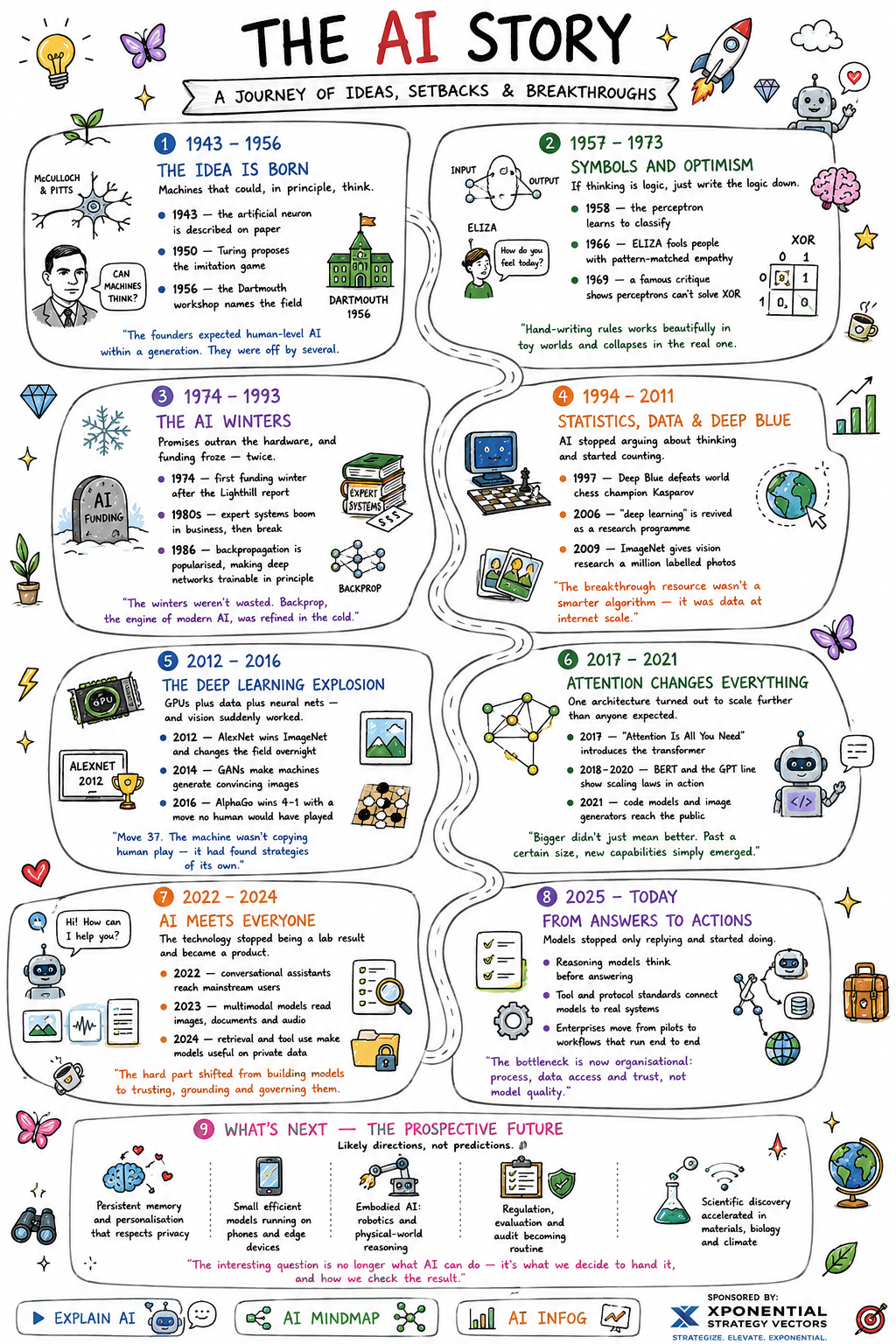
Nine chapters of the AI story — the founding idea, the winters, the breakthroughs, the twists nobody saw coming, and where it plausibly goes next. Draw an illustration wherever a picture helps.
1943 – 1956
The Idea Is Born
Machines that could, in principle, think.
McCulloch and Pitts sketched a mathematical neuron. Alan Turing asked whether a machine could imitate a human well enough that you couldn't tell. In 1956, a summer workshop at Dartmouth gave the field its name: artificial intelligence.
- 1943 — the artificial neuron is described on paper
- 1950 — Turing proposes the imitation game
- 1956 — the Dartmouth workshop names the field
The founders expected human-level AI within a generation. They were off by several.
1957 – 1973
Symbols and Optimism
If thinking is logic, just write the logic down.
Early AI tried to encode intelligence as rules and symbols: theorem provers, chess programs, ELIZA the chatbot therapist. The perceptron — a single learning layer — briefly promised machines that learn on their own.
- 1958 — the perceptron learns to classify
- 1966 — ELIZA fools people with pattern-matched empathy
- 1969 — a famous critique shows perceptrons can't solve XOR
Hand-writing rules works beautifully in toy worlds and collapses in the real one.
1974 – 1993
The AI Winters
Promises outran the hardware, and funding froze — twice.
Reports concluded AI had not delivered. Money dried up in the mid-70s and again in the late 80s after expert systems proved brittle and expensive to maintain. Quietly, though, the key ideas kept advancing.
- 1974 — first funding winter after the Lighthill report
- 1980s — expert systems boom in business, then break
- 1986 — backpropagation is popularised, making deep networks trainable in principle
The winters weren't wasted. Backprop, the engine of modern AI, was refined in the cold.
1994 – 2011
Statistics, Data and Deep Blue
AI stopped arguing about thinking and started counting.
Machine learning went statistical: spam filters, recommendation engines, search ranking. Deep Blue beat Kasparov in 1997. The internet quietly produced the fuel everything later would run on — enormous amounts of data.
- 1997 — Deep Blue defeats world chess champion Kasparov
- 2006 — 'deep learning' is revived as a research programme
- 2009 — ImageNet gives vision research a million labelled photos
The breakthrough resource wasn't a smarter algorithm — it was data at internet scale.
2012 – 2016
The Deep Learning Explosion
GPUs plus data plus neural nets — and vision suddenly worked.
In 2012 AlexNet crushed the ImageNet benchmark using graphics cards. Error rates fell year after year. Speech recognition, translation and image tagging all leapt forward. In 2016 AlphaGo beat Lee Sedol at a game people said was decades away.
- 2012 — AlexNet wins ImageNet and changes the field overnight
- 2014 — GANs make machines generate convincing images
- 2016 — AlphaGo wins 4-1 with a move no human would have played
Move 37. The machine wasn't copying human play — it had found strategies of its own.
2017 – 2021
Attention Changes Everything
One architecture turned out to scale further than anyone expected.
The 2017 transformer paper replaced step-by-step reading with attention: every word can look at every other word at once. Scale it up and abilities appear that were never explicitly trained — summarising, translating, coding, reasoning in steps.
- 2017 — 'Attention Is All You Need' introduces the transformer
- 2018-2020 — BERT and the GPT line show scaling laws in action
- 2021 — code models and image generators reach the public
Bigger didn't just mean better. Past a certain size, new capabilities simply emerged.
2022 – 2024
AI Meets Everyone
The technology stopped being a lab result and became a product.
A chat box did what a decade of papers could not: it made AI legible to ordinary people. Image generation, multimodal models that see and hear, and cheap fast models pushed AI into everyday work — writing, design, analysis, code.
- 2022 — conversational assistants reach mainstream users
- 2023 — multimodal models read images, documents and audio
- 2024 — retrieval and tool use make models useful on private data
The hard part shifted from building models to trusting, grounding and governing them.
2025 – today
From Answers to Actions
Models stopped only replying and started doing.
Agents plan, call tools, use software and check their own work. Standard protocols let them connect to company systems safely. Reasoning models trade a few seconds of thinking for far better answers on hard problems.
- Reasoning models think before answering
- Tool and protocol standards connect models to real systems
- Enterprises move from pilots to workflows that run end to end
The bottleneck is now organisational: process, data access and trust, not model quality.
What's next
The Prospective Future
Likely directions, not predictions.
Expect models that remember across time, run cheaply on your own device, act in the physical world through robotics, and are held to real standards of evidence and audit. Value will accrue less to raw models and more to the workflows built on them.
- Persistent memory and personalisation that respects privacy
- Small efficient models running on phones and edge devices
- Embodied AI: robotics and physical-world reasoning
- Regulation, evaluation and audit becoming routine
- Scientific discovery accelerated in materials, biology and climate
The interesting question is no longer what AI can do — it's what we decide to hand it, and how we check the result.