The AI Stack — Two Views
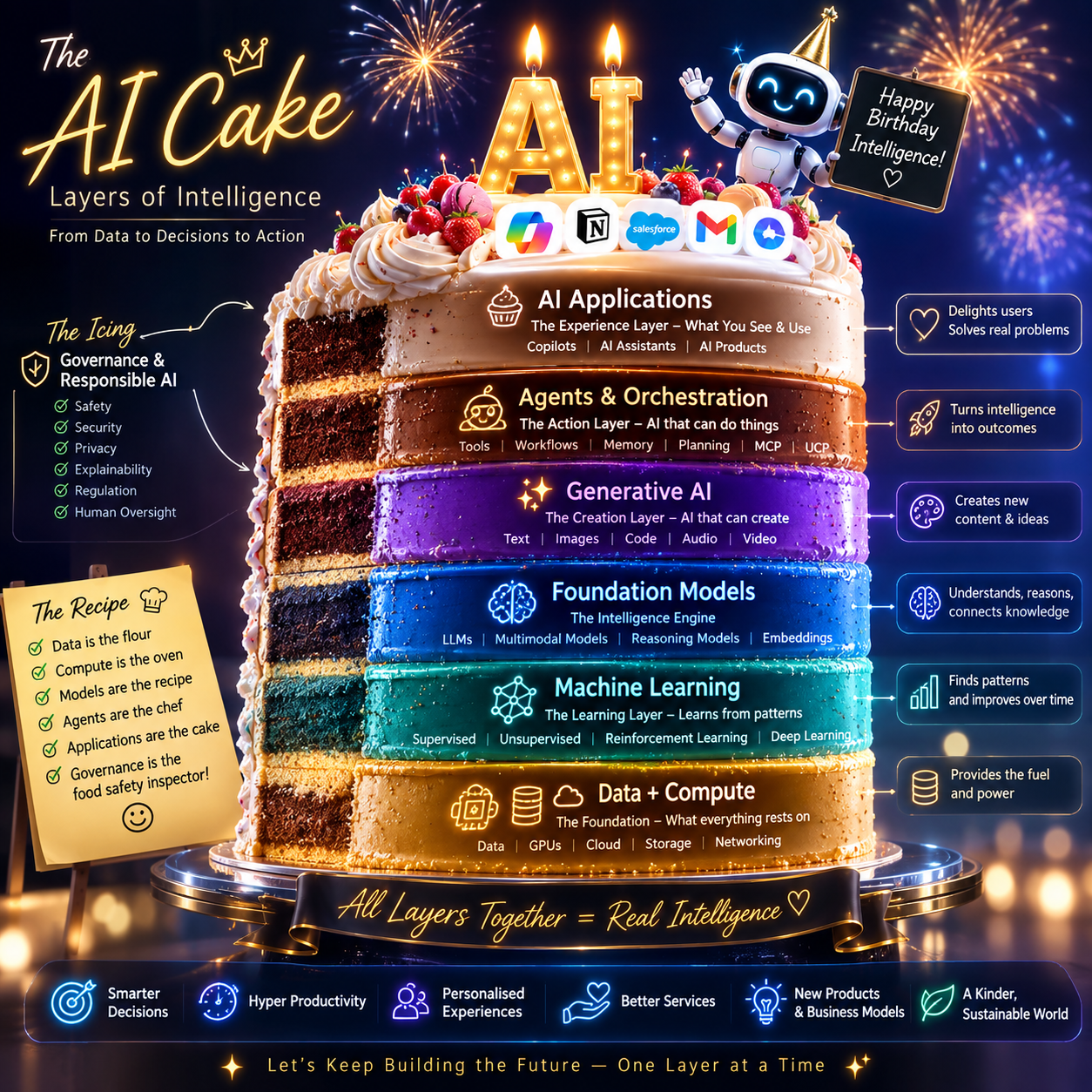
Same cake, same intelligence: from Data + Compute at the base to AI Applications at the top.
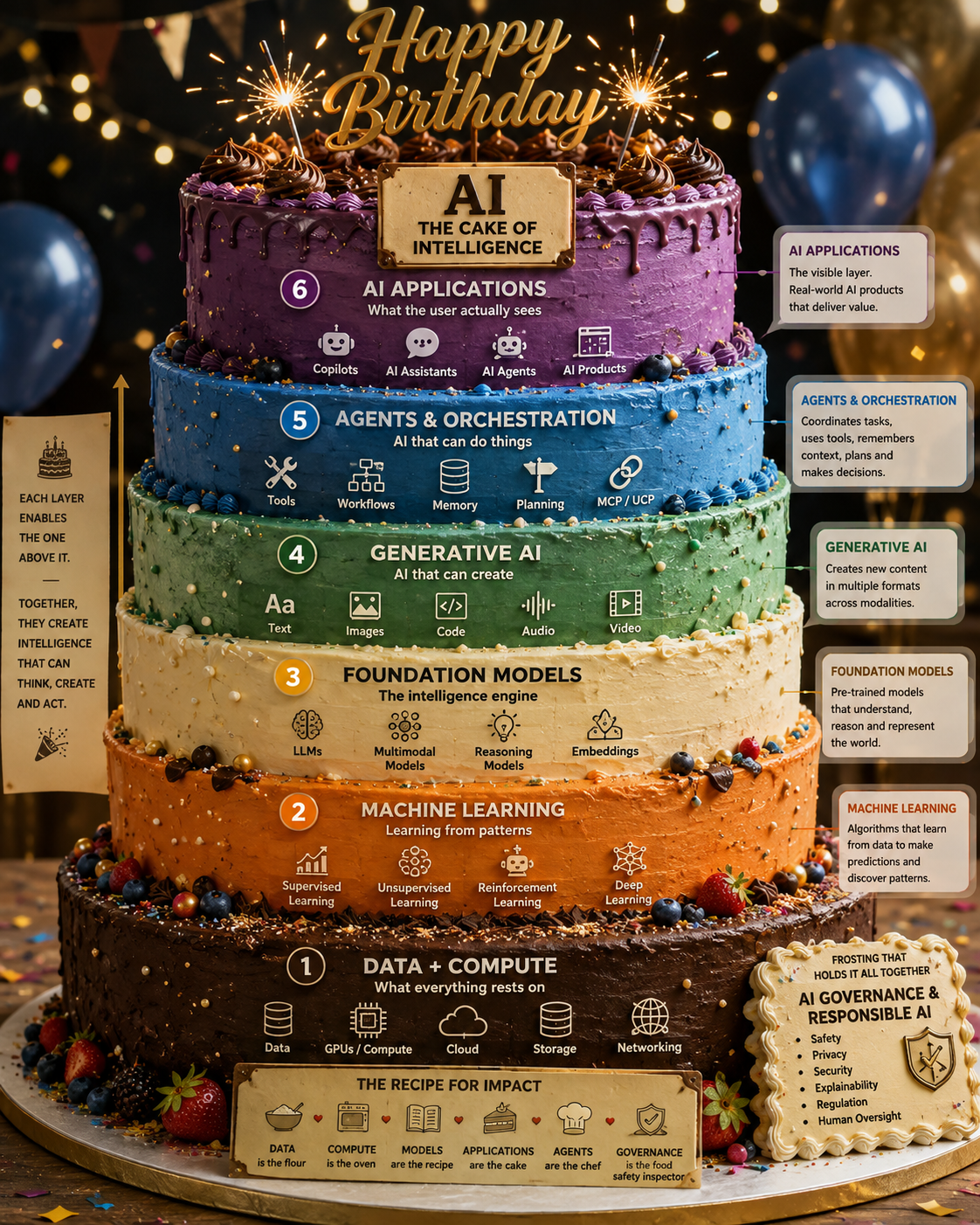
The AI industry is a stack. Value flows up from fabs and chips to clouds, models, agents and finally the apps people use. Each layer below lists the companies that matter, what they actually do, and why that layer is strategically important.
AI Applications
Where everyday people actually meet AI.
The top of the stack: products that hide all the machinery and just do a job — build a page, make a deck, research a topic, draft a contract. This is where most business value is captured, because it is the only layer a non-technical user ever touches.
- Lovable — Describe an app in plain English, get a working web product.
- Genspark — Agentic deep research that compiles answers with sources.
- Gamma — Presentations and documents generated from a prompt.
- Cursor — An IDE where the AI is a pair programmer on your codebase.
- Canva — Design for everyone, now with generative editing built in.
- Notion AI — AI woven into the place teams already keep knowledge.
- Harvey — Domain-specific AI for legal work — depth beats generality.
- Perplexity — Answer engine: search rebuilt around citations, not links.
- Salesforce — AI embedded in the system of record enterprises already run.
Agents & Orchestration
Turning a model that answers into a system that acts.
Agents plan, call tools, read and write to systems, and loop until a goal is met. Orchestration frameworks handle memory, retries, routing between models, and connecting to your data. This layer is what converts a clever chatbot into a colleague that finishes tasks.
- OpenAI Agents SDK — First-party tooling for tool-using, multi-step agents.
- Anthropic / MCP — Model Context Protocol — the standard plug for tools and data.
- LangChain / LangGraph — The most widely used orchestration and graph framework.
- CrewAI — Teams of specialised agents with defined roles.
- AutoGen — Microsoft's multi-agent conversation framework.
- n8n — Visual workflow automation with AI nodes — low-code agents.
- Zapier — Connective tissue between thousands of business apps.
Model & Inference Layer
The engines — and the fiercest competition in tech.
Frontier labs train the models everything else depends on. Capability, price and licence differ sharply: closed frontier models lead on hardest reasoning, open-weight models win on control and cost. Serious builders stay model-agnostic and route work to whichever engine fits the task.
- OpenAI — GPT family; set the consumer expectation for AI in 2022.
- Anthropic — Claude; strong on long-context reasoning and enterprise safety.
- Google DeepMind — Gemini; deep integration with search, cloud and devices.
- Meta — Llama; open weights that made local and private AI mainstream.
- Mistral — Efficient European open models for cost-sensitive workloads.
- DeepSeek — Proved frontier-class reasoning can be trained far cheaper.
- Qwen (Alibaba) — Leading open multilingual family out of China.
- Cohere — Enterprise-focused models for retrieval and ranking.
- xAI — Grok; models trained and served at extreme scale.
AI Frameworks & Tooling
The workbench where models are built, tuned and served.
Training frameworks, model hubs and inference servers. Their importance is quiet but total: the choice of framework decides how fast a lab can iterate, and serving tooling decides whether inference costs are sustainable at scale.
- PyTorch — The de facto research and training framework.
- TensorFlow — Still heavy in production pipelines and mobile deployment.
- JAX — High-performance numerical computing behind much of Google's training.
- Hugging Face — The public commons for models, datasets and evaluation.
- NVIDIA NeMo — End-to-end toolkit for training and customising large models.
- vLLM — Serving engine that slashed the cost of high-throughput inference.
Cloud / AI Platform
Where AI actually runs — and where the bills land.
Hyperscalers rent the compute, host the models, and increasingly bundle governance, evaluation and data pipelines. For enterprises the platform choice is usually decided by where the data already lives, not by which model is best this quarter.
- AWS — Bedrock plus the widest install base; Trainium for cheaper training.
- Microsoft Azure — Deepest OpenAI integration and enterprise compliance story.
- Google Cloud — Vertex AI, TPUs and Gemini in one vertically integrated stack.
- Databricks — Lakehouse: keeps training and governance next to the data.
- Snowflake — Governed enterprise data with AI functions run in place.
- IBM — watsonx for regulated industries and hybrid deployments.
Compute / Acceleration
The scarcest resource in the industry.
Every capability jump so far has been bought with more compute. Whoever supplies accelerators — and the software that locks developers to them — captures an outsized share of the profit pool. This is why chip supply is now a geopolitical question, not just a procurement one.
- NVIDIA — GPUs plus CUDA — the moat is the software, not only the silicon.
- AMD — Instinct accelerators; the credible second source.
- Google TPU — Custom silicon that lets Google train without paying the GPU tax.
- AWS Trainium / Inferentia — In-house chips to cut training and serving cost.
- Intel — Gaudi accelerators and the broader CPU install base.
Data & Storage
No proprietary data, no durable advantage.
Models are increasingly commodities; your data is not. Warehouses, lakehouses and vector databases decide whether an AI system can retrieve the right context at the right moment — which is what separates a demo from something people trust.
- Databricks — Lakehouse architecture for training-grade data at scale.
- Snowflake — Governed, queryable enterprise data as the AI substrate.
- MongoDB — Operational data with vector search built in.
- Pinecone — Managed vector database purpose-built for retrieval.
- Weaviate — Open-source vector search with hybrid keyword ranking.
- Milvus — High-scale open-source vector store for billion-item corpora.
Foundation / Physical Layer
AI is a physical industry wearing a software costume.
Underneath everything sit fabs, power, cooling, networking and buildings. Data-centre capacity, grid connections and high-bandwidth interconnects are now the real constraints on how fast AI can scale — more than algorithms are.
- TSMC — Fabricates almost all leading-edge AI silicon.
- ASML — Sole supplier of EUV lithography — the ultimate chokepoint.
- Networking (InfiniBand, Ethernet) — Interconnect speed caps how large a cluster can train.
- Power & cooling — Grid access and water are now siting decisions for AI.
- Storage (SSD, object) — Petabyte-scale corpora have to live somewhere fast.
How to read the map
- Scarcity sits at the bottom. Chips, power and fabs are hard to copy, so margin concentrates there.
- Differentiation sits at the top. Models converge; workflows, data and trust are what customers actually pay for.
- Stay swappable in the middle. Route across models and clouds so a price cut or a new release is an upgrade, not a rebuild.