Thought Leadership on AI

What the people building AI actually believe

← AI Kaleido
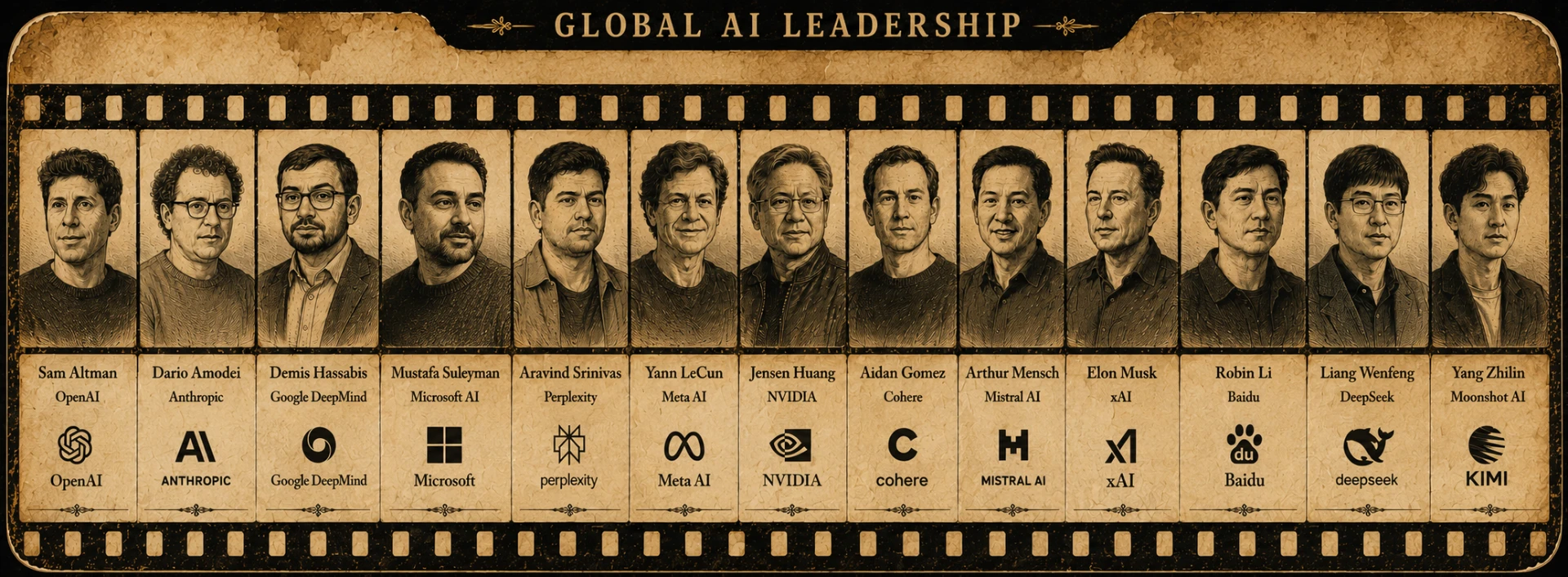
Global AI Leadership — the people and companies shaping artificial intelligence
Global AI Leadership: portraits and logos of key figures and organizations in AI.

A wall of quotes from Silicon Valley and Wall Street leaders — each one paired with the argument sitting underneath it, so you get the thinking and not just the soundbite.

Reid Hoffman

LinkedIn co-founder, PayPal executive

“AI now may be the steam engine of the mind.”
Hoffman also describes AI as an “intelligence amplifier” and argues it increases human agency.
“It's not human vs. AI. It's human with AI.”
Probably the strongest one-line formulation of the augmentation thesis.
“The AI is my tool, companion, car, et cetera, as I navigate things.”
AI isn't necessarily a replacement for human agency; it can become the infrastructure through which humans exercise more of it.
“AI is our cognitive “mobile scaffolding.””
The metaphor: AI helps humans build intellectual cathedrals that previously weren't possible.
“The surest way to prevent a bad future is to steer toward a better one.”
From his Superagency thesis: don't merely fight bad AI futures — actively construct better ones.

Peter Thiel

PayPal co-founder

“Crypto is libertarian, AI is communist.”
His argument: AI's ability to aggregate and centralize information gives it a fundamentally different political character from crypto.
“If we ever were to get artificial intelligence… this would be a momentous event.”
Genuine human-level AI shouldn't be read as an employment or economic story — it would be a civilization-level political event.
“AI is sort of the buzz word of the day.”
The contrarian point: “AI” covers everything from ordinary machine learning to genuinely autonomous intelligence, and those aren't the same phenomenon.

David Sacks

PayPal executive / investor

“The speed definitely matters.”
Sacks frames AI as a race across infrastructure, applications, adoption and users — not simply a race to invent better models.
“At this point, stopping progress in AI would be equivalent to halting the U.S. economy.”
An unusually strong statement about AI's macroeconomic significance.
“AI is actually hyper democratized.”
AI has diffused to individuals faster than almost any previous major technology.

Keith Rabois

PayPal executive / investor

“AI fundamentally changes the organization of technology companies.”
One of his strongest recent arguments: AI collapses the traditional boundaries between product, design and engineering.

Jensen Huang

NVIDIA CEO

“We're at the beginning of a new industrial revolution.”
AI isn't another software cycle: computing itself is becoming an intelligence manufacturing industry.
“Every industry, every company, every country must produce a new industrial revolution.”
Every organization and nation needs to industrialize AI — not simply consume it.
“AI is the greatest equalizer.”
Falling compute costs and accessible AI democratize capabilities once restricted to the best-resourced organizations.
“Every young person should become an AI expert.”
Especially relevant to careers: AI dramatically lowers the knowledge barrier across professional fields.

Satya Nadella

Microsoft CEO

“We must reimagine our mission for a new era.”
His AI thesis goes beyond automating existing jobs: build systems that empower people to create their own tools.
“What does empowerment look like in the era of AI?”
AI changes the relationship between people and software — from using predefined applications to creating and directing intelligent systems.

Jamie Dimon

JPMorgan Chase CEO

“Every single thing we do in AI and technology has potential value — revenue enhancement, cost avoidance, risk and fraud reduction.”
Notable because the framing isn't hype; it's portfolio economics and measurable enterprise value.

Elon Musk

PayPal co-founder / xAI founder

“AI may exceed the sum of human intelligence in about five years.”
Considerably more extreme than the augmentation thesis: he expects AI to surpass the combined intelligence of humanity on his projected timeline.